At Folkestone Street, recent conversations with whānau have highlighted differing perspectives
around the use of tamariki home languages in early childhood settings. Some families shared
experiences where languages such as Chinese were discouraged, raising questions about
whether speaking a tamaiti’s first language in a centre environment is beneficial. These
discussions prompted us to reflect on our practice and how well we are supporting children’s identity, language, and communication.
Grounded in a child-led philosophy, we recognise that children communicate in many ways,
including through language. We are committed to creating an inclusive environment where all
children’s identities, cultures, and languages are valued. Supporting home languages is not just about language, it is about ensuring children feel safe, understood, and experience a strong
sense of belonging.
In practice, we actively encourage the use of home languages within our daily interactions.
Kaiako who speak languages such as Mandarin and French intentionally use these to communicate with tamariki, helping us better to understand their needs, cues, and interests.
When children hear familiar language, they are more likely to feel heard, build trusting
relationships, and engage confidently in their environment (Education Review Office [ERO],
2017). As outlined in Te Whāriki, children’s learning is strengthened when their language,
culture, and identity are recognised (Ministry of Education, 2017).
This approach directly reflects our centre’s strategic focus on strengthening communication and
collaboration with whānau. By valuing and incorporating home languages, we create more
authentic communication with tamariki and build meaningful, reciprocal partnerships with
whānau. Listening and responding to family aspirations ensures our practice is inclusive,
responsive, and grounded in relationship-based teaching.
Our practice aligns with the Education Review Office focus on high-quality teaching and
learning, where children’s learning is supported through strong partnerships with whānau and a
curriculum that reflects their identities, languages, and cultures (ERO, 2017). By encouraging
the use of home languages, we create a responsive and inclusive environment where children
can communicate, participate, and learn in ways that are meaningful to them. Research
supports this, showing that when children see and hear their home language within their
environment, it strengthens their sense of belonging and inclusion, while also supporting the
development of communication, thinking skills, and confidence (Ball, 2012; Genishi, 2002;
Smith, 2009).
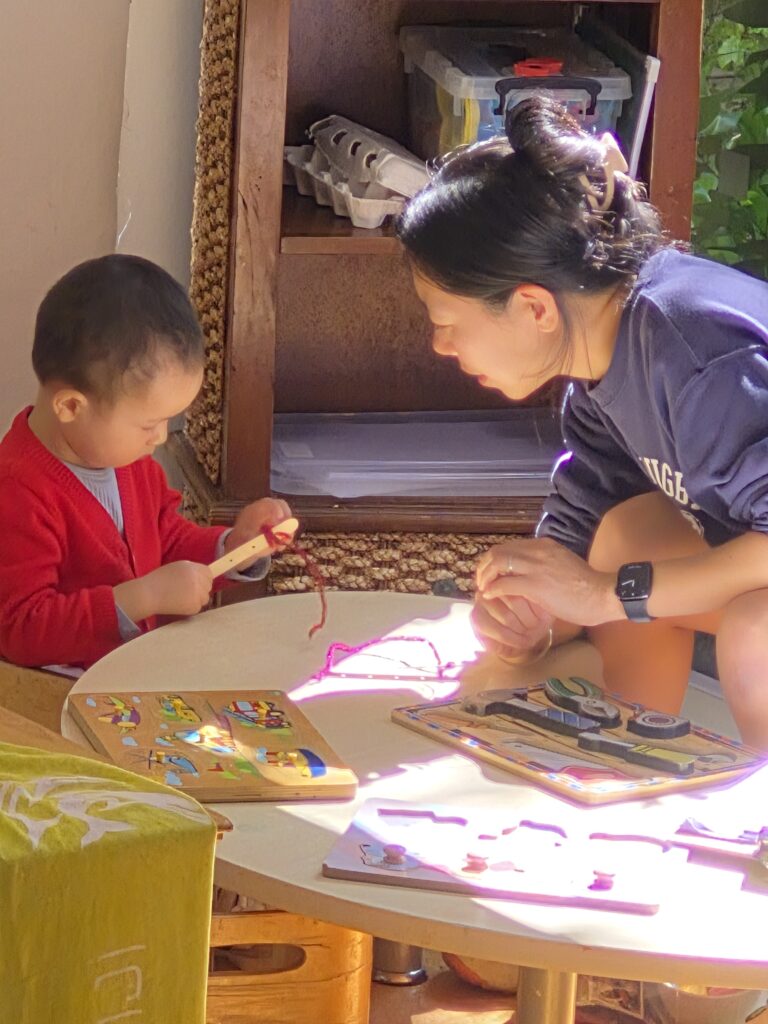
We see this impact in our everyday practice. Tamariki who hear their home language show
increased confidence, stronger engagement in play, and deeper connections with kaiako and
peers. Familiar language creates emotional security, allowing children to settle more easily and
participate as capable learners. When children feel understood, they are more likely to
communicate their ideas, explore their environment, and build relationships. In this way,
supporting home languages contributes to positive learning outcomes across both wellbeing
and learning.
One of our kaiako, Hannah, reflects on this in her practice:
“I’ve seen how using children’s home language makes a real difference to their wellbeing and
engagement. For Chinese children, hearing familiar language helps them feel comfortable and
connected – like a ‘home away from home’. I’ve also noticed it benefits all children. When I sang
‘The Itsy Bitsy Spider’ in Mandarin, the group listened closely and waited calmly together, and even during care moments, children asked for the song again. It’s a simple way language
supports connection and engagement.”
As a team, we will continue to build on this practice by being more intentional with our use of home languages, strengthening whānau voice, and providing resources that reflect the
languages within our community. Supporting home languages is an ongoing journey, and one
that continues to strengthen our commitment to inclusive, responsive, and relationship-based
teaching.
At Folkestone Street, we believe that when tamariki languages are valued, they don’t just learn, they thrive.
References
Ball, C. E. (2012). The richness diversity brings: Diverse languages and literacies in early childhood
education (Master’s thesis, Auckland University of Technology). Tuwhera Open Access Theses &
Dissertations. https://openrepository.aut.ac.nz/server/api/core/bitstreams/1b6878ff-2369-4fd8-a068-6867cd6ef890/content
Education Review Office (2017). Extending their language, expanding their world: Children’s oral
language (birth-8 years). Wellington: Education Review Office.
Genishi, C. (2002). Research in review. Young English language learners:
Resourceful in the classroom. Young Children, 57(4), 66-72.
Ministry of Education. Te Tāhuhu o te Mātauranga. (2017a). Te Whāriki/He whāriki matauranga mō ngā mokopuna o Aotearoa: Early childhood curriculum. https://www.education.govt.nz/early-childhood/teaching-and-learning/te-whariki/
Smith, L. (2009). How do young children acquire and develop literacy skills in New Zealand’s educational settings? Retrieved on 23 March 2012 from www.wharenui.school.nz/Literacy%20Acquisition.doc
Written by Maddy Boss